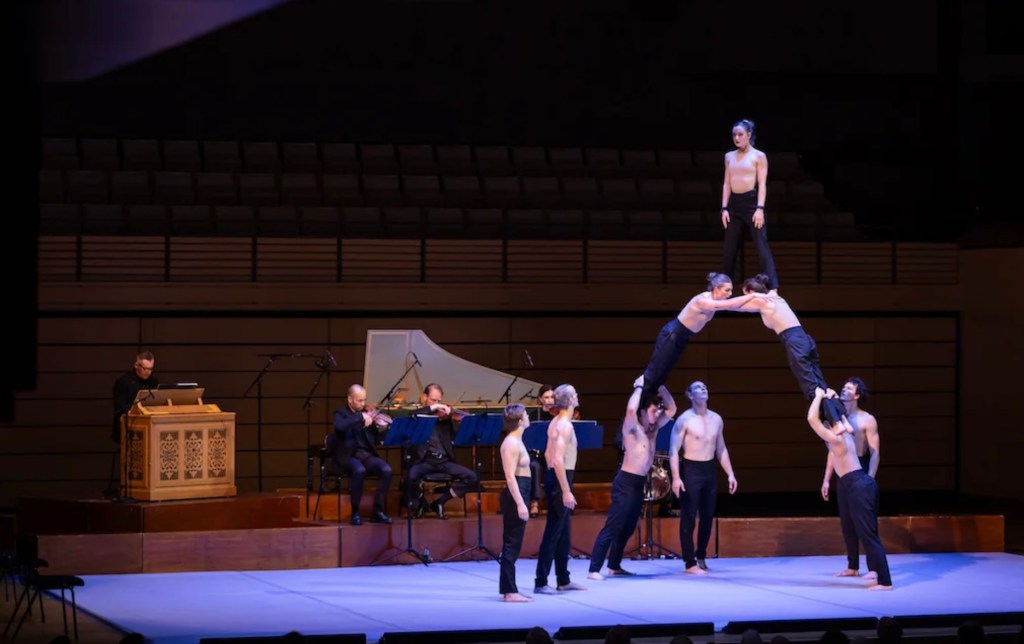
Photo (c) David Kelly
Circa & The Art of Fugue
Australian Brandenburg Orchestra
Melbourne Recital Centre
Sat 9 Aug 2025
I saw the most extraordinary thing on a stage last night. Or should I say, off it. In the air above the stage.
Circa was here to do Bach, and it flew. A circus arts company from Brisbane, its performers are dancers, actors and acrobats all at once.
You could say the same of musicians of the Australian Brandenburg Orchestra, in full flight for the whole 85 minutes.
But no one in the band was likely to break more than a sweat or a string. Metaphorical flight is undoubtedly safer.
So, why risk a spinal injury for Baroque music?
It might be in the title of this collection Bach finished late in his life, the Art of Fugue. Fugue means to fly, or to flee; to leave the ground or leave the scene. The doors were closed, though; no one was going anywhere. Except up.
The first heights scaled were muscial, by the band of Bach experts; fugue as a form is insanely difficult to play. I have never found it much easier to listen to, much though I love reading about what an extraordinary creation it is, especially in the hands of JS Bach. His fugues contain mathematical beauty and codes, and as architectural forms are thought flawless.
But give me his keyboard preludes, cello suites, violin concertos and solo violin partitas for company any day over those weird old fugues. They’re like a brilliant relative you’re sat next to at a family dinner for three hours, someone you know is a genius with surely the most amazing stories to tell. But they are rubbish at conversation; they speak in riddles if at all. Where’s that lovely garrulous cousin who works making expensive car ads? That cello suite in G! It’s lovely.
Fugues, I have found, are almost never lovely.
That’s not to say I find all Bach’s fugues inaccessible to the ear. I adore one or two of the cavernous minor fugues that lumber about in timeless shadow deep into The Well Tempered Clavier. And I can get into the Musical Offering, especially after reading the story of its creation as a great F-k You Your Majesty to the king who during a Baroque pissing contest set Bach what he thought was an impossible melody to turn into counterpoint. What Bach pulled off was a kind of musical alchemy. The book Evening in the Palace of Reason by James R. Gaines tells that story in a way that would make three hours at dinner fly. Can we invite him next year?
Art of Fugue, which the book also enthused about, has however remained mute to me, staring at its drink in the corner. Gaines made it sound so amazing! I have listened to it so many times over the years, with the ear of faith, ready to hear the musicological equivalent of the Emperor’s New Clothes. What would unlock the wonder? What would get that taciturn genius talking so I could…get it?
Last night, by about halfway through the 19 pieces performed over 85 minutes, I got my answer in two words: human fugue.
Each musical fugue is a single idea played by one instrument, then taken up by multiple parts or voices. It is repeated with variations by those different voices at different times and melodic intervals.
With each piece, the 8 or 9 Circa performers similarly took a single idea and played with it, took it up in multiple ways. They formed so many multi-part animals, then unformed and reformed them again with variations as they moved across the stage. Like Bach in his lighter moments, they set up expectations – look! I’m falling! – then subverted them. No, someone caught me! Or: No, I rolled away unhurt!
The audience gasped many times. What if these athletes we knew to weigh more than they seemed to up there, actually fell? We would have to trust their strength, their muscle memory. At one point a woman stood on a man’s head to form an 11-foot flesh totem pole. I must trust his neck, I thought.
As for that question, what if they fall? Bach was concerned with this too, though the pain of physical injury was not the hell on his mind. He arranged harmonic structure as a bridge to the heavens, to please his God.
The performers’ movements seemed driven by this question of greater falls too. We were worried about them falling a metre or several; Bach had more spiritual heights and depths in his sights, late in his life, and the circus seemed to know this.
These human fugues took so many forms; performers moved alone, in pairs, trios, quartets and more. Sometimes all eight (a ninth came on for the latter parts) moved like a creature now extinct, lost to evolution for being too vast, complex, ungainly.
At other times that creature froze in the form of a bridge or a church spire. Bach and his architecture of the spheres had its earthly match, a perfect load-bearing structure in flesh and bone.
For a moment only though. The bridges and churches fell to earth and panting humans emerged from their wreckage, like after an earthquake.
I started to see that question – what if they fell – answered on the sweaty faces of these determined performers.
Because surely to know flight is to know falling. How many times have these young people fallen literally in rehearsal or performance? How many broken bones and ligaments had to heal to build these places of crossing over, of worship?
The final piece of the 19 is a fragment of a fugue. It stops so suddenly. The lights went out and that was it.
Bach died from complications after a rogue eye surgeon got at him. What a way to go, blinded, feverish, in pain. But I suspect he died in some spiritual peace. After all, every church spire he played under pointed to where he knew he was off to next.
He had built his bridges to heaven. No need to fly.
Bach here on Earth (sorry) I walked home with my friends. Other Bach jokes may have been made. I decided fugue still eludes me a bit. But after that extraordinary performance, I felt lighter, and more connected to my people and place under what of the stars you can see in this city.
Bach is good like that.
Circa helped me see and feel a bit of Bach that’s for years been stuck up here in my head, yet to fall into my heart. It’s such a difficult piece of music in so many ways. But seeing it done like this, I somehow felt hope about other difficult things in life.
Many of the most difficult things in life have to be done alone, that’s why they are the most difficult.
For everything else, if we are lucky, we have each other.
Circa and the ABO did a difficult thing together. They made a human fugue, and it flew.
 The Normal Grown-Up